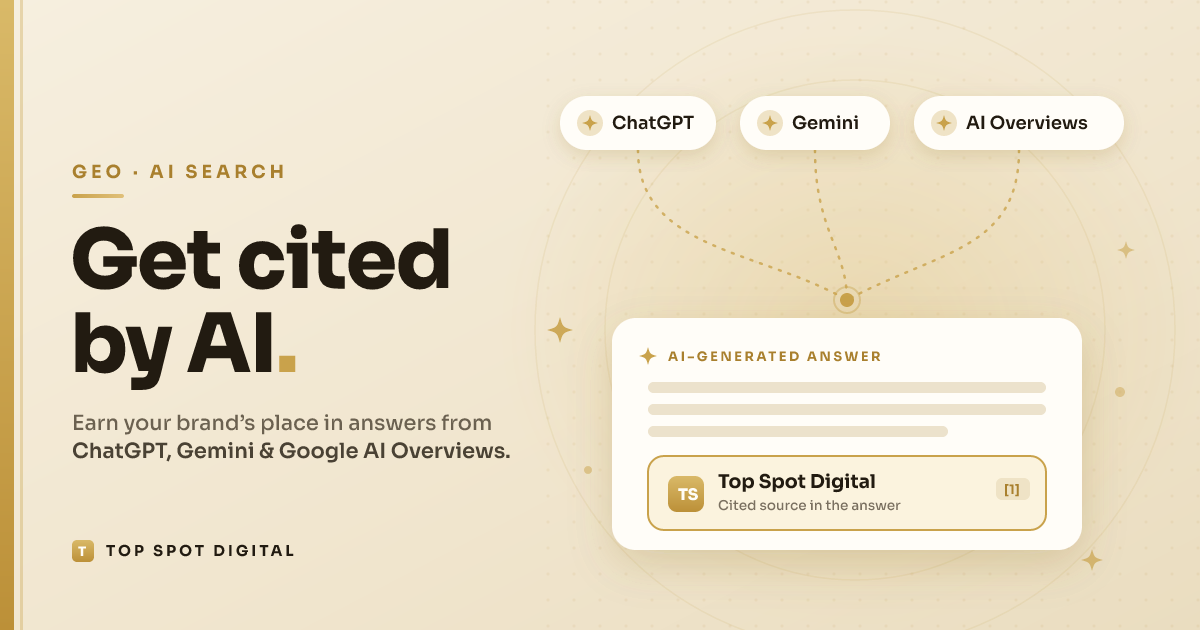
To get your business cited by ChatGPT, Gemini and Google's AI Overviews, you need to win on three fronts at once: be a clearly defined entity these systems recognise and trust, publish content structured so a model can lift a clean, correct answer from it, and earn enough corroboration across the wider web that naming you feels safe to the model. Brands that get all three right move from invisible to quoted. Brands that nail only one stay absent, or worse, get described inaccurately.
This guide explains how AI engines actually decide what to cite, then walks through what to do about it, platform by platform, with the mistakes that quietly keep most businesses out of the answer.
The shift you are optimising for
For two decades, the search game was about ranking a page in a list and earning the click. That model is fracturing. A large and growing share of queries now end inside an answer: a paragraph generated by an AI system that synthesises several sources and, increasingly, names them. The user reads the answer and acts. The ten blue links, if they appear at all, sit beneath the fold of attention.
This is the world Generative Engine Optimisation (GEO) is built for. The objective is no longer only to rank for a query. It is to be the source the answer is built from.
Sometimes that still earns a click. Just as often it earns something subtler and more valuable: being the brand the buyer trusts because the AI vouched for you. Our full approach lives on our GEO services page.
How AI engines actually choose what to cite
There is a crucial distinction most articles skip. Appearing in an AI answer can happen two very different ways, and they call for different work.
Training-data presence versus live retrieval
Some answers are generated purely from the model's training data, a frozen snapshot of the web from months earlier. You cannot directly edit that, but the brands that show up in it are the ones that were well-represented and consistently described across the web when the snapshot was taken. The other route is live retrieval, where the engine searches the web in real time, reads a handful of pages, and cites them. This is where most of your influence sits, and it is growing as every major engine moves toward real-time grounding.
Google's AI Overviews are grounded in Google's own index, so classic SEO fundamentals carry over directly. ChatGPT's search blends a web index with its model. Perplexity crawls live and shows its sources prominently. Gemini draws on Google's ecosystem. Different plumbing, but the same underlying question in every case: of the sources available, which are relevant, extractable and trustworthy enough to put in front of the user?
The three pillars of citability
Everything that works in GEO ladders up to one of three pillars. Think of them as the criteria a model is implicitly scoring you against.
Pillar one: entity clarity
Before a model can cite you, it has to be confident about what you are. AI systems reason about the world in entities, the people, organisations, products and concepts in a knowledge graph, and the relationships between them. If your brand is a fuzzy or contradictory entity, the model hedges by leaving you out.
Strengthening your entity means describing your business identically everywhere it appears: the same name, the same one-line description, the same specialisms, the same locations. It means a tight, factual About page; Organisation and, where relevant, LocalBusiness schema with sameAs links to your authoritative profiles; consistent details across LinkedIn, Companies House, industry bodies and directories; and, for businesses with genuine notability, presence in the structured sources that feed knowledge graphs, such as Wikidata. The test is simple: ask each engine "what is [your brand]?" If the answers are vague, dated or wrong, your entity needs work before anything else will land.
Pillar two: extractability
The second pillar is whether a model can lift a clean, self-contained, correct answer from your page without effort. Models work in passages, not whole documents. A page can rank well in classic search yet be almost impossible to quote because the answer is buried, hedged, or spread across five scrolling paragraphs.
Extractable content shares a recognisable shape:
- It answers the question in the first sentence or two, then expands. Lead with the conclusion, not the wind-up.
- It uses descriptive, question-shaped headings that mirror how people actually ask.
- It keeps one idea per paragraph, so a passage can stand alone when extracted.
- It uses lists, definitions, comparison tables and step-by-step instructions, all formats a model can transpose cleanly.
- It is marked up with schema (FAQ, Article, HowTo, Product) so the meaning is machine-readable, not just the words.
If a model has to dig for your point, it will quote the competitor who made theirs in the first line.
Pillar three: corroboration and authority
The third pillar is the one most businesses underinvest in, and it is often decisive. A model is far more comfortable naming a brand that the rest of the web already vouches for. That means earned mentions in credible publications, inclusion in third-party "best of" and comparison lists, genuine reviews on the platforms your sector trusts, references in industry resources, and even discussion on community sites, which several engines weight surprisingly heavily because they read as authentic human consensus.
Crucially, these mentions do not always need to be links. AI systems read unlinked brand mentions as corroboration in a way classic SEO never fully did. A pattern of consistent, accurate references across many independent sources is what turns a recognised entity into a recommended one.
Platform by platform: where the nuances differ
Google AI Overviews and AI Mode
Because Overviews are grounded in Google's index, the entry ticket is strong conventional SEO: crawlable, fast, well-structured pages that already earn visibility. From there, passage-level clarity and schema do the heavy lifting. If you are not indexed and reasonably visible in classic Google results, you will not surface in its AI answers either, so SEO and GEO are tightly coupled here.
ChatGPT
ChatGPT answers from a mix of training data and live web search. That makes both routes matter: long-run, consistent web presence to influence the model's baseline, and clean, retrievable pages to be picked up when it searches live. Brands described consistently across many reputable sources tend to recur in its answers.
Perplexity
Perplexity leans hardest on live retrieval and displays its citations openly, which makes it the best free barometer of your GEO progress. If Perplexity starts citing you for your target prompts, you are doing something right. If it never does, study the sources it cites instead and reverse-engineer why they qualified.
Gemini
Gemini sits inside Google's ecosystem, so the same entity and content fundamentals that serve Overviews tend to serve it, with Google's broader signals about your organisation feeding in.
What most businesses get wrong
Three mistakes account for most failures to get cited. The first is treating GEO as a content problem only, publishing more blog posts while ignoring the off-site corroboration that actually moves the needle. The second is optimising the wrong unit: polishing whole pages for ranking while leaving individual passages unquotable. The third, and most damaging, is ignoring accuracy. If engines are describing your business wrongly, your priority is not more visibility, it is correcting the entity, because amplifying a wrong description is worse than being absent.
How to measure it
You cannot manage what you do not track, and "are we showing up in AI" is too vague to act on. Build a structured measurement habit:
- Assemble a prompt set of 30 to 50 questions a real buyer would ask, split into branded, category and problem-led queries.
- Run them across ChatGPT, Gemini, Perplexity and Google AI Overviews, and log whether you are named, how accurately, and which competitors appear.
- Track share of citation: your mentions as a percentage of all brand mentions across the set.
- Flag and correct any inaccuracies in how you are described, tracing them back to the sources feeding them.
- Re-run monthly, because models update constantly and a gain is not a finish line.
A realistic timeline
Entity fixes and on-page extractability can register within weeks. The corroboration layer, the earned mentions and reviews that turn recognition into recommendation, compounds over months. Anyone promising instant, guaranteed AI citations is selling something. GEO behaves like SEO: steady, cumulative, and durable once it takes hold.
Frequently asked questions
Can I pay to be cited by ChatGPT or Gemini?
No. Citations in organic AI answers are earned through relevance, clarity and trust, not bought. Some engines are introducing separate ad units, but those are labelled advertising and distinct from the cited sources in an answer. The work to be cited overlaps with SEO and digital PR, not media buying.
How is GEO different from SEO?
SEO optimises a page to rank in a list of results and earn a click. GEO optimises your brand and content to be selected, quoted and recommended inside an AI-generated answer. They share most of their foundations, but GEO adds entity definition, passage-level extractability and off-site corroboration as first-class priorities. Most businesses now need both.
Do I need to be on Wikipedia or Wikidata?
It helps if you genuinely qualify, because these sources feed the knowledge graphs models reason over. But notability rules are strict, and a forced or low-quality entry can do more harm than good. For most businesses, consistent descriptions across reputable third-party sources matter more than chasing a Wikipedia page.
How long until I see results?
On-page and entity work can show up within a few weeks. The off-site corroboration that drives consistent citations typically takes months to compound. Treat GEO as an ongoing discipline rather than a project with an end date.
What if AI engines describe my business incorrectly?
Treat it as the top priority. Identify the sources feeding the error, correct them at source, tighten your own entity signals, and re-check. Amplifying visibility while the description is wrong only spreads the error faster.
Does GEO only matter for big brands?
No. Because so few businesses have done this work, there is a genuine first-mover advantage. A focused smaller business with a clear entity and strong niche corroboration can out-cite larger, vaguer competitors in its specific category.
Want to see exactly how AI engines describe your brand today, and where competitors are cited instead of you? Book a call and we will run an LLM visibility audit across all four engines.